A Photo Booth Operator's Guide
One of the first decisions a photo booth operator has to make sounds simple: should the booth print classic 2×6 strips or full-size 4×6 photos?
At first glance, this looks like a design choice. In practice, it affects almost everything around the print: the template, cutter settings, media planning, branding space, guest experience and even how you package your service.
From our perspective as a professional photo-printer dealer, there is no universal winner. The better format depends on the event, what the client wants guests to take home, and how your printer and booth software are configured.
Written by EventPrinters.com — serving professional photo printing and event customers since 1996.
Reviewed: August 2026
Manufacturer specifications are identified separately from our dealer recommendations and workflow opinions.
2×6 or 4×6: Which Should You Offer?
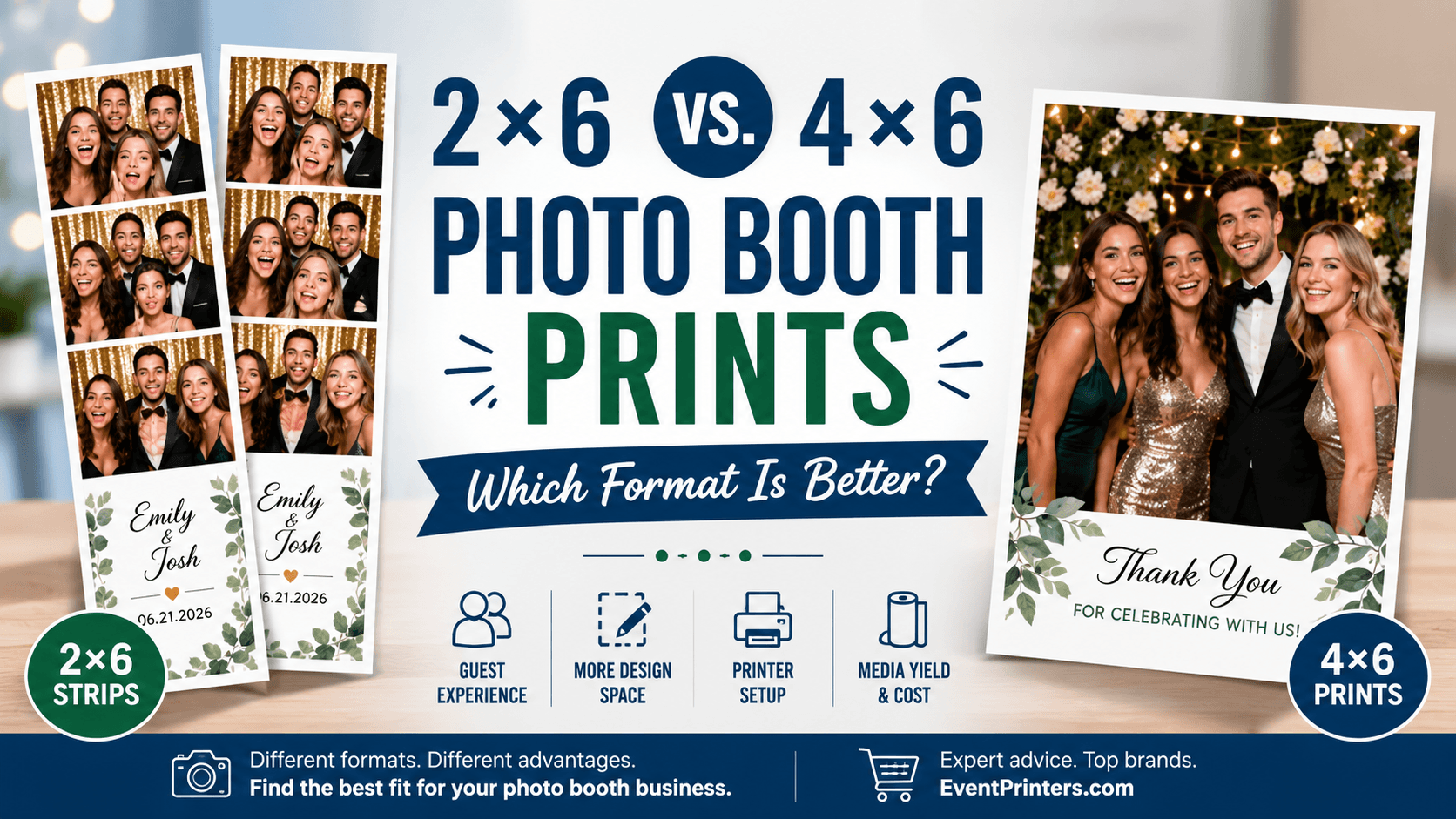
If the client wants the unmistakable, nostalgic “real photo booth” look, the 2×6 strip is hard to beat. It works naturally with several poses, is easy to hand out in pairs, and fits beautifully into wedding guest books.
A 4×6 print feels more like a traditional photograph. You have far more room for the people in the picture, a larger hero image, decorative artwork, logos or sponsor branding.
And for many operators, there is no reason to permanently choose one over the other. A properly configured professional system may let you offer both from the same general 4×6 media workflow.
The Real Difference Between a 2×6 Strip and a 4×6 Print
Size is obviously the first difference, but it is not the most important one. The two formats create a different kind of keepsake.
The Classic Photo Booth Strip
When most people picture a traditional photo booth, this is what they imagine: several small photographs stacked vertically with the event name or date at the bottom.
The format encourages a sequence of poses. Guests have room to be serious in one frame, silly in the next, and completely ridiculous by the final shot.
That sequence is part of the charm.
The Full-Size Photo
A 4×6 print gives the design room to breathe. Faces can be larger, groups are easier to see, and the layout can accommodate much more artwork or branding without everything feeling crowded.
It also feels more like a conventional photograph—something a guest might put on a refrigerator, desk or in a frame after the event.
How Do You Actually Print Two 2×6 Photo Booth Strips?
This is where new operators sometimes get confused.
In a common professional workflow, you are not loading the printer with a two-inch-wide roll of photo paper.
Instead, the booth software creates a 4×6 print job containing two 2×6 designs side-by-side. A compatible printer and driver then cut the completed print down the middle.
| Step | What Happens |
|---|---|
| 1. Guests pose | The booth captures the sequence of photos. |
| 2. Software builds the layout | The images are inserted into the 2×6 template. |
| 3. Two strips are placed on a 4×6 canvas | The print job sent to the printer contains both strips. |
| 4. Printer produces the 4×6 | Standard compatible 4×6 media is used. |
| 5. The print is cut | The compatible cutter workflow separates the two 2×6 strips. |
One thing we would never skip before an event: make an actual strip print. Seeing the template correctly on the screen does not prove that the physical cut, orientation and margins are correct.
2×6 vs. 4×6: Side-by-Side
| What Matters | 2×6 Strip | 4×6 Print |
|---|---|---|
| Classic photo booth feel | Excellent | Good, but less traditional |
| Several poses | Natural fit | Works well in collage layouts |
| Large faces / group photos | Limited space | Much better |
| Branding space | Limited | More flexible |
| Wedding guest books | Excellent | Good |
| Frameable keepsake | Less traditional | Excellent |
| Two physical copies | Easy with a two-up strip layout | Usually requires printing a second copy |
| Template design | Less room, so every element matters | More forgiving |
Media Yield: Where Operators Need to Be Careful
Print counts become confusing when people mix up 4×6 prints with individual 2×6 strips.
If one 4×6 media cycle produces two individual strips, your strip count can be twice the number of 4×6 print cycles.
DNP DS-RX1HS Example
Standard RX1HS 4×6 media provides 700 4×6 prints per roll.
In a two-strip workflow, that can mean:
- 700 4×6 print cycles per roll;
- 2 individual 2×6 strips from each print;
- up to 1,400 individual strips from one roll;
- two 700-print rolls in a standard case;
- up to 2,800 individual strips from the full case.
DNP DS620A Example
Standard DS620A 4×6 media provides 400 prints per roll.
Using the same two-strip logic:
- 400 4×6 print cycles per roll;
- up to 800 individual 2×6 strips per roll;
- two rolls per case;
- up to 1,600 individual strips per case.
Important distinction: two strips do not consume two sheets of 4×6 media. They are two physical pieces created from one 4×6 print cycle.
If you're planning an event and want to estimate how much media to bring, use our Photo Booth Media Calculator .
Designing for the Final Print, Not the Computer Screen
A template that looks spacious on a 27-inch monitor can feel very different once it is only two inches wide.
This is especially important with sponsor logos, wedding dates and small decorative typography.
For 2×6 Strips
Keep the design disciplined. The photographs should still be the reason people want to keep the strip.
Avoid trying to squeeze a logo, hashtag, URL, event date, couple's names and decorative artwork into the same small footer unless all of it remains comfortably readable.
For 4×6 Prints
You have more freedom. A larger hero image, multiple photo cells and stronger corporate branding can coexist without overwhelming the photograph.
This is one reason 4×6 layouts can work particularly well for corporate activations and branded experiences.
Common 300-DPI Canvas Sizes
| Print Format | Common 300-DPI Design Size |
|---|---|
| 2×6 | 600 × 1800 pixels |
| 4×6 portrait | 1200 × 1800 pixels |
| 4×6 landscape | 1800 × 1200 pixels |
Our advice: print the final artwork before sending it to the client for approval. What matters is not how the overlay looks in Photoshop or your booth software. What matters is what the guest will actually hold.
Which Format Works Better for Different Events?
These are not rigid rules. They are practical starting points.
Weddings: We Like 2×6 Strips
The classic strip works naturally with the social, playful side of a wedding booth.
If a guest book is included, the format becomes even more useful: one strip can go home with the guests while the second can be placed in the book next to their message.
Corporate Activations: 4×6 Often Has an Advantage
Corporate clients usually want more than a photograph. They may need logos, sponsor graphics, a campaign message or a branded frame.
A larger canvas simply gives the designer more room to do that without shrinking the people in the photo.
Birthdays and Quinceañeras: Let the Design Decide
Either format can work beautifully.
If the client wants the traditional booth experience, use strips. If the theme involves elaborate artwork and the print is meant to be a larger souvenir, 4×6 may look better.
Glam Booths: We Usually Prefer 4×6
Glam booths tend to emphasize the finished portrait rather than a sequence of funny poses.
A larger 4×6 gives the photograph more impact and feels more like a finished portrait.
What Should You Look for in a Photo Booth Printer?
Don't select a printer simply because somebody says it “does 2×6.” Look at the entire workflow: media capacity, cutter support, print speed, portability and compatibility with your booth software.
| Printer | 4×6 | 2×6 | Why an Operator Might Choose It |
|---|---|---|---|
| DNP DS620A | Yes | Compatible strip workflows | Fast 8.3-second 4×6 output |
| DNP DS-RX1HS | Yes | Two strips from 4×6 in compatible workflows | 700-print 4×6 roll capacity |
| DNP QW410 | Yes | Compatible strip/perforated workflows | Very compact and approximately 13 lb |
If you're still deciding which printer makes the most sense for your business, see our Best DNP Photo Booth Printers Guide .
Should You Offer Both Formats?
We think this is where many operators miss an opportunity.
Instead of deciding that your company is permanently a “strip booth” or a “4×6 booth,” you can treat the print format as part of the package.
Classic Booth Package
Two 2×6 strips with several poses, event name and date.
Premium Print Package
Full 4×6 output with a larger photograph and more design space.
This gives the client an actual choice and can help distinguish one package from another without requiring an entirely different booth.
Common 2×6 Printing Mistakes We Would Avoid
- Designing a strip correctly but forgetting the two-up print layout.
- Sending the right artwork to the wrong printer paper-size setting.
- Assuming the cutter is configured correctly without making a physical test.
- Making the logo or event date unreadably small.
- Testing the printer on 4×6 but never testing the actual strip cut.
- Assuming every printer handles 2×6 in exactly the same way.
- Confusing perforated media with a printer's automatic cutter-based strip workflow.
If the event sells 2×6 strips, the final pre-event test should end with two real 2×6 pieces in your hand—not merely a successful 4×6 print.
Our Recommendation: Start with the Guest, Not the Printer
Our approach is to decide what the guest should receive first and work backward from there.
If the client wants the unmistakable traditional photo booth experience, several poses and a pair of fun keepsakes, 2×6 makes a lot of sense.
If they want a larger photograph, stronger branding or something that feels more like a finished portrait, start with 4×6.
2×6 Is Usually Better When...
- the traditional booth look is important;
- multiple poses are part of the fun;
- you want two physical strips;
- the event includes a guest book;
- the client likes a compact keepsake.
4×6 Is Usually Better When...
- the photograph should be larger;
- you need significant branding space;
- the print is meant to feel premium;
- you are offering a portrait or glam experience;
- the layout requires more room.
Then—and only then—confirm that your printer, media, driver and booth software can produce the format reliably.
There is no value in offering the perfect layout if the workflow is difficult to reproduce consistently during a busy event.
Related Photo Booth Printing Guides
2×6 vs. 4×6 Photo Booth FAQ
What is the traditional photo booth strip size?
The classic narrow format is generally 2×6 inches. Professional workflows commonly place two 2×6 designs within one 4×6 print job and then cut them into two individual strips.
Can two 2×6 strips come from one 4×6 print?
Yes, when the photo booth software, printer, driver and cutter workflow support it. Two strips are positioned side-by-side inside a single 4×6 print area.
Do two 2×6 strips use two sheets of 4×6 media?
No. In a standard two-up workflow, both strips come from one 4×6 media cycle.
Which is better for a wedding photo booth?
We often prefer 2×6 strips for a traditional wedding booth, particularly when a guest book is included. One strip can go to the guests while the other is placed in the book.
Which format is better for corporate events?
A 4×6 often provides more usable space for logos, campaign graphics, sponsor messaging and a larger photograph. However, a well-designed branded 2×6 strip can also work very well.
What pixel size should a 2×6 template be?
A common 300-dpi 2×6 design is 600 × 1800 pixels. Follow the exact requirements of your booth software and printer workflow.
What pixel size should a 4×6 template be?
At 300 dpi, common dimensions are 1200 × 1800 pixels for portrait orientation or 1800 × 1200 for landscape.
How many 2×6 strips can RX1HS 4×6 media produce?
Standard RX1HS 4×6 media provides 1,400 total 4×6 print cycles per two-roll case. If every cycle produces two individual strips, the theoretical maximum is 2,800 individual 2×6 strips.
Can the DNP DS620A print 2×6 strips?
Yes. The DS620A supports professional photo booth strip workflows when configured with compatible media, software and printer settings.
Should my photo booth business offer both sizes?
If your equipment can support both reliably, offering 2×6 and 4×6 gives customers a useful choice between the classic strip experience and a larger photographic keepsake.
How We Put This Guide Together
EventPrinters.com is operated by Southtrend Corp. and has served the professional photo printing industry since 1996.
We wrote this article from the point of view of somebody actually building a photo booth printing workflow—not simply comparing two paper dimensions.
The printer and media specifications discussed here were checked against current manufacturer information. Template and cutting concepts were also compared with current photo booth software documentation.
Recommendations about weddings, corporate activations, guest books, package design and workflow are our dealer perspective rather than rules issued by DNP or photo booth software developers.
We also intentionally avoid giving either format a universal “winner.” A format that is excellent for a traditional wedding booth may not be the best choice for a branded corporate activation.
Need Help Choosing a Photo Booth Printer or Media?
Tell us whether you plan to offer 2×6 strips, 4×6 prints or both, along with your expected event volume and printer requirements. We can help you compare professional photo printers and media options.
Questions? 305-653-0037 · info@eventprinters.com